
A coding agent enters the data warehouse
A data engineer drops a one-liner into Claude Code: "Add patient_visit_count to dim_patient." Twenty seconds later, Claude has read the project, scanned sources.yml, and written plausible-looking SQL. dbt compile is happy. The PR merges Friday evening.
At 2 AM Saturday, the scheduled job fires. The model references PATIENT_ID, but the actual warehouse column is SUBJECT_ID. The run fails in production.
Nothing about the SQL looked obviously wrong. Claude inferred the schema from surrounding code and naming patterns instead of verifying it against the actual warehouse.
Claude Code can write a dbt model. What it can't do, by itself, is run that SQL against your warehouse before you ship it.
This is one instance of a broader pattern. General coding agents like Claude, Cursor, and Copilot are designed for software where the source code is the truth. Data engineering inverts that: the warehouse is the truth, dbt YAML is its description, the agent's SQL is a guess. When the warehouse and the code disagree, only the warehouse is right, and the agent has no way to ask.
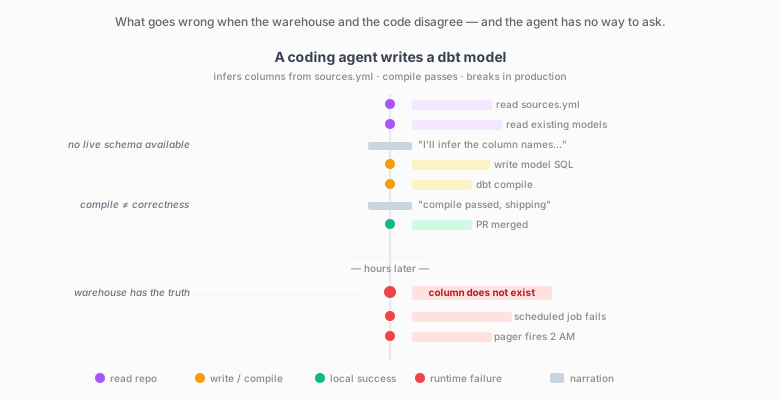
This isn't a hypothetical. In our first experiment, bare Claude shipped a dbt model with two hallucinated column names that looked right based on the surrounding code but didn't exist in the actual Snowflake table. dbt compile passed. The model would have failed on first real run.
The altimate-code plugin catches this because Claude calls it before generating, and it actually queries the warehouse for the real columns.
The altimate plugin gives Claude warehouse hands: schema introspection, cross-warehouse execution, dbt-idiomatic defaults. That's what turns a code generator into something that finishes the task.
We ran three categorically different experiments to find out where this matters and where it doesn't. The answer is more interesting than "always" or "never.", and reveals four common blind spots when deploying coding agents on data engineering tasks.
The three experiments
We deliberately picked task shapes that stress different parts of an AI data engineering workflow:
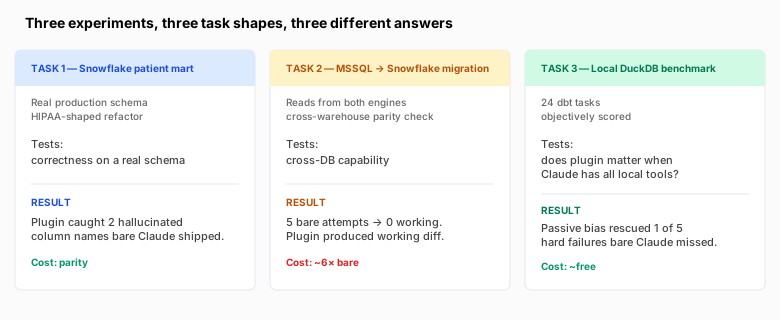
Each task answers a different question about where the plugin actually earns its keep. Taken together, they give you a framework to predict where it'll pay off on your workloads.
Blind spot #1: Schema hallucination on real warehouses
The task: A real Snowflake mart-layer refactor of a patient-360 model with HIPAA constraints, and dozens of column-level decisions.
What happened bare: Claude generated a working-looking model. Two column names were inferred from context, close to right but wrong. dbt compile was happy. Code review by a human would likely have missed them (they looked plausible).
What happened with the plugin: Claude delegated schema introspection to altimate-code's altimate-dbt columns tool, which hit Snowflake directly and returned the actual columns. The hallucinated names were caught before generation.
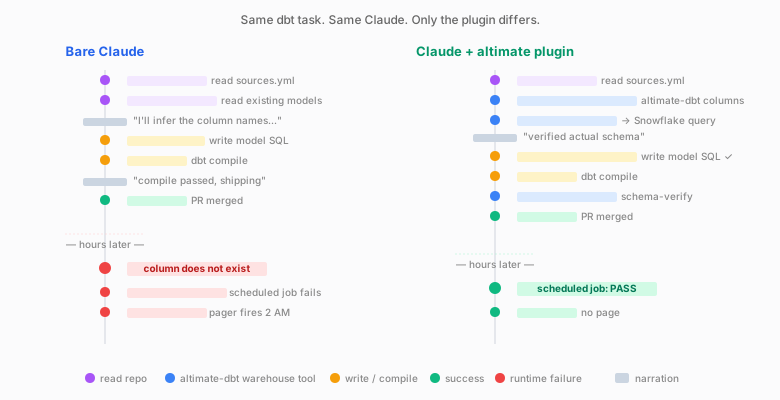
The cost was a wash. Plugin runs landed at near-parity per-token spend. So the correctness win is essentially free for any real-warehouse work.
If your Claude is touching real warehouse models, the (free) plugin pays for itself by not shipping broken column names.
Blind spot #2: Cross-warehouse work the agent can't reach
The task. Migrate a customer's project from MSSQL to Snowflake. Validate parity. This requires connecting to both warehouses, reading from one, comparing aggregates to the other.
What happened bare. Five attempts in a row, Claude crashed on the connectivity layer. No pyodbc driver. No pymssql. No idea how to find MSSQL credentials. Five runs produced zero working output.
What happened with the plugin. altimate-code's pre-baked warehouse adapters drove the cross-DB diff end-to-end across four internal sub-sessions, with 9+ real pyodbc.connect() calls and a working parity report at the end.
The honest cost: ~6× a bare-Claude run. But bare-Claude's run produced nothing. The right comparison isn't dollars-per-attempt, it's dollars-per-correct-answer, and bare-Claude's denominator is zero.
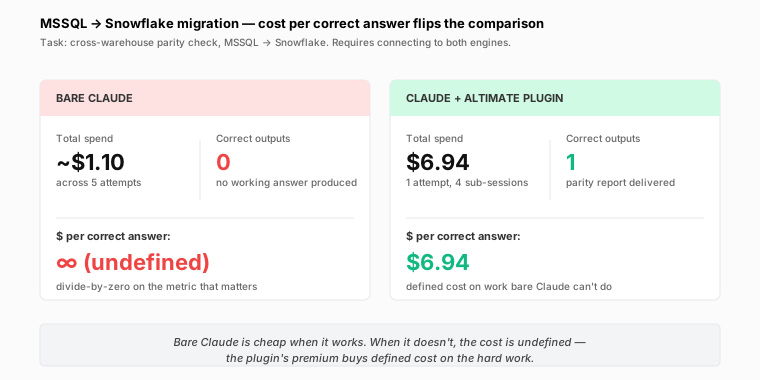
For cross-warehouse migrations, parity work, or source-of-truth reconciliation, the plugin isn't a nice-to-have. It's the only path that finishes.
Blind spot #3: Default SQL patterns aren't dbt-idiomatic
This was the surprise.
The benchmark. ADE-Bench: 24 dbt tasks running against local DuckDB, objectively scored. Crucially, Claude has everything it needs locally: no cross-warehouse, no missing drivers. This is the "where the plugin shouldn't matter" scenario.
The headline result. Of 5 hard tasks bare Claude failed, the plugin's passive presence (just being installed; no Skill tool invocation, no subprocess delegation) rescued 1. Specifically: an ADE-Bench task called intercom003 went from FAIL → PASS for an extra ~$0.13 in tokens.
Here's what changed in the output:
| Operation | Bare Claude (FAIL) | With plugin loaded (PASS) |
|---|---|---|
| Removing duplicate rows | implicit join, missed dupes | QUALIFY ROW_NUMBER() OVER (...) |
| Handling missing values | "empty values expected" | COALESCE(..., 0) everywhere |
| Computing time differences | date_diff('second', ...) |
EXTRACT(EPOCH FROM ...) / 60 |
Bare Claude defended its wrong output as expected behavior. Plugin Claude wrote dbt-idiomatic SQL. The Skill tool never fired. The plugin's value here was purely the loaded skill descriptions sitting in Claude's context, biasing it toward correct patterns.
And the intercom003 task wasn't the only one we ran. We tested the full 5 hard ADE-Bench tasks across 4 configurations (passive, forced consultation, mandatory delegation) to map which mechanisms actually flipped failures:
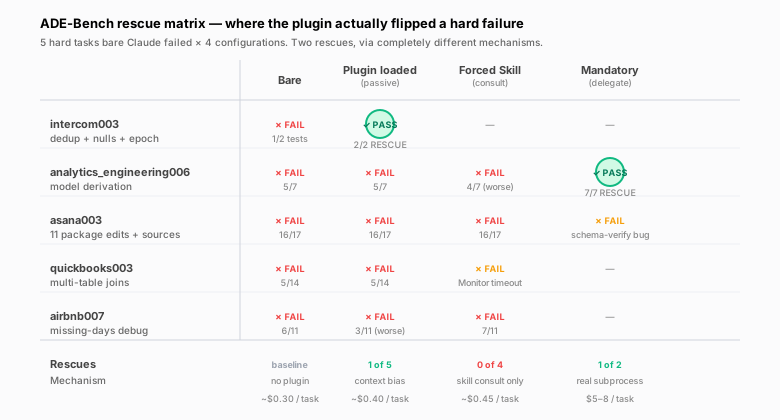
Two rescues, two completely different mechanisms. The passive presence rescue (intercom003) was nearly free. The mandatory delegation rescue (another ADE-Bench task, analytics_engineering006) cost 18× a bare run but turned 0/7 tests into 7/7. Forcing the Skill tool to fire without demanding actual delegation rescued nothing. Claude reads the guidance, then proceeds to do the work itself.
Even if Claude never delegates to altimate-code, the plugin's presence is a free correctness prior on dbt-shaped code.
The cheapest mode of adoption (just enable the plugin and walk away) measurably improves dbt output quality.
Blind spot #4: Wasted exploration on tasks the agent could solve
The first three blind spots are about things Claude can't do at all without the plugin. This one is different: it's about tasks Claude can already solve and whether the plugin makes those cheaper or more expensive. The answer is surprising: just having the plugin loaded changes how Claude explores, even when no plugin tools ever fire.
The intercom003 task rescue hinted at something deeper than tool augmentation: the plugin was changing Claude's search behavior even when no plugin tools fired. So we asked whether that same passive context bias also reduced cost on tasks Claude already solved correctly.
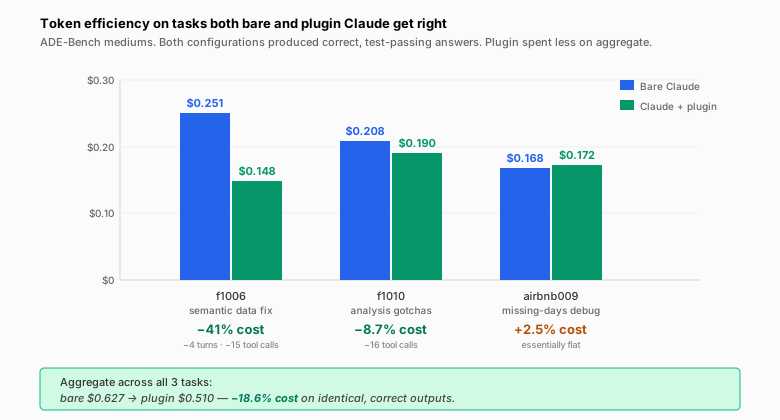
We replayed three ADE-Bench medium tasks where bare Claude already produced correct, test-passing answers (f1006 semantic data fix, f1010 analysis gotchas, airbnb009 missing-days debug), this time with the plugin enabled. Both configurations passed all tests. We compared turns, tool calls, and spend.
(Note: airbnb009 above is a medium-complexity task, and different from airbnb005-shape, the simpler task class discussed in the next section of this article.)
The aggregate is a 18.6% cost reduction with the plugin enabled, on tasks where both produce identical, correct outputs. Two of three tasks were cheaper with the plugin; one was essentially flat. The biggest win, f1006, saw the plugin use 4 fewer turns and 15 fewer tool calls than bare.
Importantly, this isn't from the plugin's deterministic tools firing. In all three runs, altimate-dbt was never invoked. Claude used the same Read/Bash/Edit tools either way. The savings come from the skill descriptions in Claude's system prompt biasing exploration: plugin Claude reads fewer files, skips more dead-end debugging paths, converges to the answer with less noise.
Loaded plugin context is a prior, not a tax. It guides exploration toward the answer, even when the bundled tools never fire.
This generalizes the intercom003 task result: passive context bias improves both correctness and efficiency on real dbt work.
The decision framework
Here's a single chart you can use to decide, task by task, which mode of the plugin matters and what it'll cost:
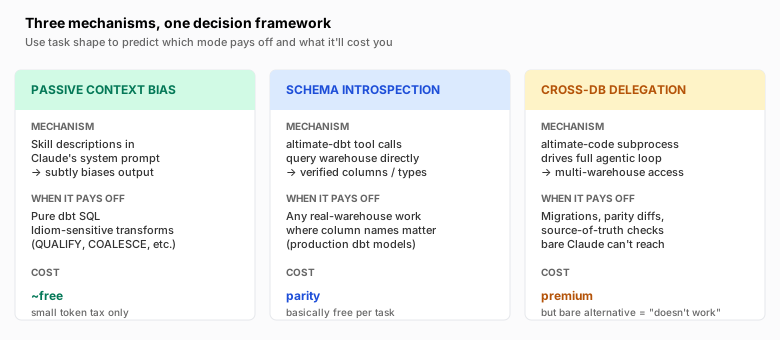
Use this to predict where the plugin will pay off on your workloads.
Where the plugin doesn't help
It's not a free lunch everywhere. Two patterns to know about before you adopt:
On the simplest model-creation tasks (
airbnb005-shape), plugin presence costs +25% with no correctness gain. These are tasks bare Claude one-shots in a handful of turns; there's no exploration loop for the context bias to short-circuit. On a richer mix of dbt mediums (Blind spot #4) the aggregate flipped the other way to −18.6%, but the simplest end of the spectrum is a small tax.The Skill tool is advisory, not delegating. Even forcing it to "fire" via system-prompt nudges doesn't translate to Claude actually executing altimate-code. We tested this. Don't over-invest in prompt tricks. Just install the plugin and let the passive context bias do the work, then prompt invoke altimate-code for cross-warehouse tasks.
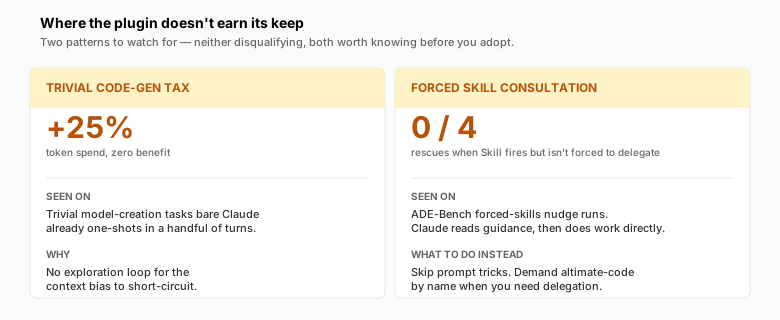
The pattern is consistent: the plugin shines on the work that's actually hard. For trivial tasks, it's a small tax. For warehouse-shaped, multi-DB, or idiom-sensitive work, it's the difference between a working answer and no answer.
Recommendation: Leave the plugin on by default. The +25% overhead on trivial tasks is small in absolute terms (these are cheap, short runs), and dynamically toggling introduces friction that costs more in engineering time than it saves in tokens. The aggregate across a realistic mixed workload still favors leaving it enabled. If you're running a batch of pure staging model scaffolding with no warehouse lookups, that's the one case worth disabling it — but it's the exception, not the workflow to optimize for.
How to adopt: — the 5-minute path
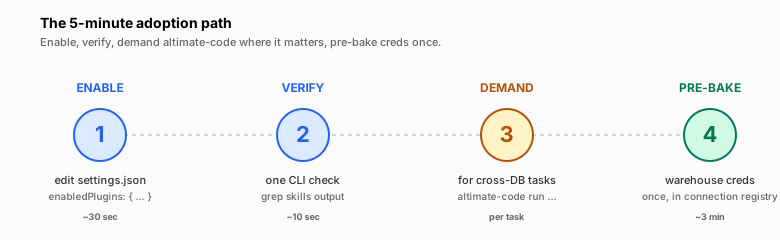
Step 1. Add to ~/.claude/settings.json:
{
  "enabledPlugins": {
    "data-engineering-skills": true
  }
}
Step 2. Verify it loaded:
claude --print "list available skills" | grep -i altimate
Step 3. For cross-warehouse and parity tasks, demand altimate-code explicitly in the prompt:
Use altimate-code to drive the cross-DB diff
Step 4. Pre-bake your warehouse credentials in altimate-code's connection registry once. Saves re-doing it per task and avoids credential leakage into prompts.
The bottom line
The altimate plugin doesn't make Claude smarter at SQL. It makes Claude competent at the parts of data engineering that aren't SQL: schema introspection, cross-warehouse connectivity, dbt-idiomatic defaults. And on the dbt work it already could do, it does it with fewer tokens.
For data teams running Claude on real warehouse work, that's the difference between a code generator and an agent that finishes the task.
Bare Claude is cheap when it works. When it doesn't (when the warehouse can't be reached, or when the column names are wrong), the cost is undefined. And even when it does work, plugin Claude usually gets there cheaper.
Try it. Altimate Data Engineering Skills Plugin for Claude Code
If you run it on your next migration or parity task, we'd love to hear what shape of work it helped, or didn't.
All three experiments used Claude Sonnet 4.6 uniformly. Sample size is small per task (1-2 runs per configuration); the task shapes are deliberately divergent, so treat the numbers as directional rather than precise.